Removing the CTO as the Bottleneck: Building an AI-Native Operating Layer Inside Hero Group

In a small company, the CTO often becomes the point where business intent gets translated into technical reality.
The visible work is architecture, infrastructure, code, pull requests, and technical judgment. The less visible work is holding the map of software, data, product history, customer context, operations, old edge cases, and hidden constraints.
Someone needs a report, and the CTO knows where the data lives. Someone asks whether a new idea is simple or expensive, and the CTO translates the question into schema, permissions, code paths, deployment risk, and sequencing. Someone sees something odd in the business, and the CTO becomes the query engine, the debugger, and the explainer.
That is useful for a while. Early on, it gives the company speed. But as the company grows, it turns technical leadership into a reactive translation queue, and the CTO becomes a bottleneck precisely because they have too much context.
The internal AI work I have been doing at Hero Group is my attempt to move the company toward that kind of AI-native operating model.
One part of that work, and the part I want to focus on here, is the internal operating layer: how our own team gets answers, creates artifacts, follows up on decisions, inspects systems, and turns intent into work without routing every step through me. The goal is not to remove engineering judgment. The goal is to reserve engineering judgment for work that actually needs it, instead of spending it on translation work created by systems that are hard for non-engineers to operate directly.
That is the lens through which I watched YC’s recent discussion on becoming an AI-native company. What stayed with me was how familiar the operational problem felt. Their examples were different, but the shape was similar: give teams a way to express intent in natural language, connect the agent to real company context, and build the review boundaries around the places where it can act.
AI becomes genuinely useful inside a company when it is connected to the company’s context, tools, permissions, workflows, review loops, and artifacts. Without that, it is mostly a clever assistant sitting outside the real work.
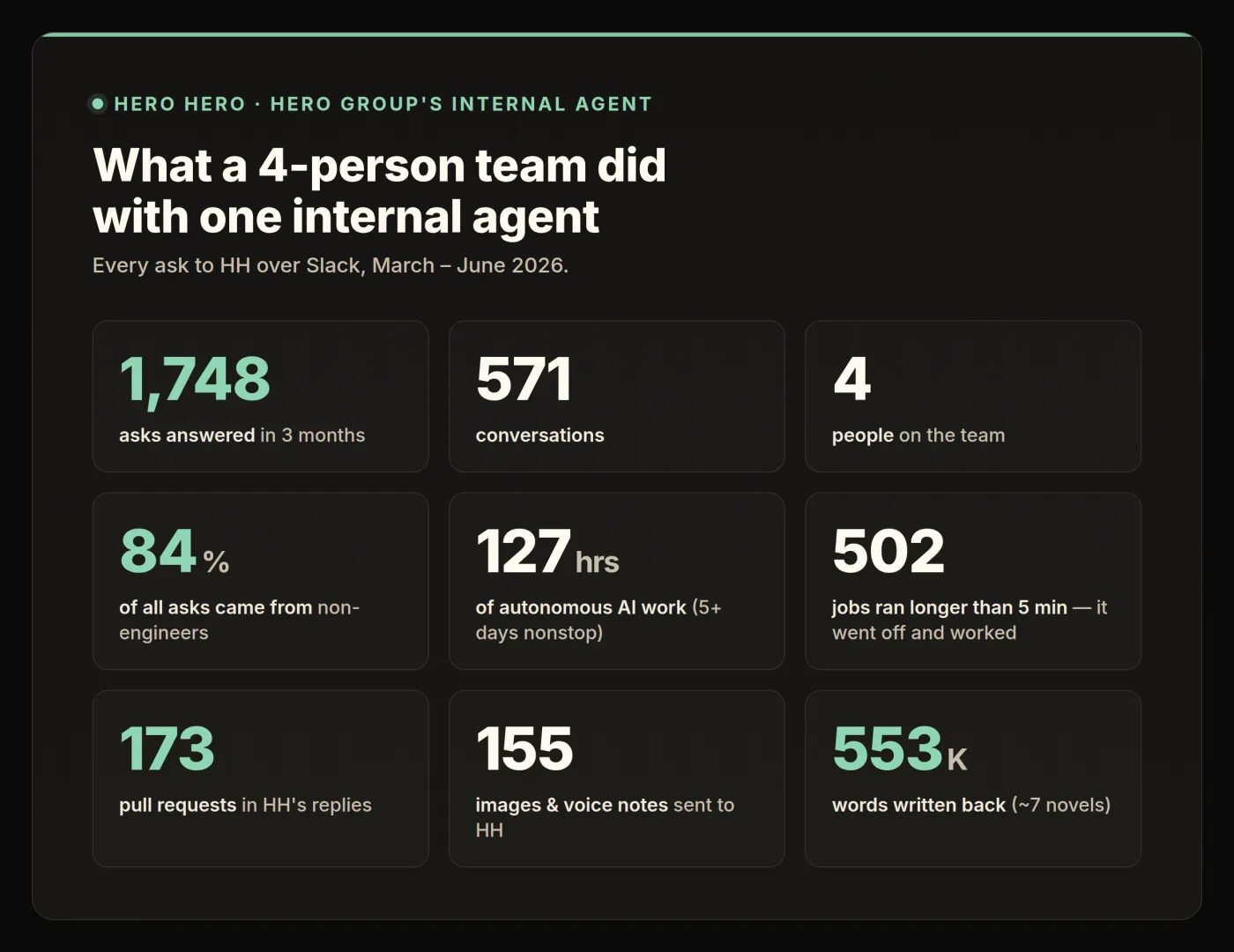
A four-person team, one internal AI agent, and three months of real usage.
AI-Native Is An Operating Model
The phrase “AI-native company” is easy to flatten into marketing. It can mean a product has AI features, employees are encouraged to use ChatGPT, or a company has a few internal automations running in the background. The version I care about is operational: a company where internal systems are redesigned around the assumption that AI can safely sit close to the work, read context, use tools, create first drafts, inspect systems, ask for review, produce artifacts, and hand work back to humans at the right boundary.
That requires more than prompts. It requires architecture.
It also requires meeting people where they already are.
For us, that means Hero Hero, our internal AI agent, lives directly in the tools the team already uses: Slack for everyday interaction and Basecamp for the more durable project-management layer. Our team was already comfortable in those places. If the AI required everyone to move into a new cockpit, it would have become one more system to remember. Putting the agent inside the surfaces where work already happens made it feel less like “using an AI tool” and more like asking for help in the normal flow of work.
The system still has to know where context lives, which tools exist, what it can do without approval, what it must escalate, how to produce outputs people can inspect, and how to leave a trail. But the interface has to stay natural. AI should adapt to the team more than the team adapts to the AI.
Hero Hero Is An Operating Interface
Chat is the surface of an internal AI system, not the substance.
Hero Hero, or HH internally, matters because it sits near the actual operating context of the company. It can work with internal documentation, plans, code, read-only data, Slack, Basecamp, email, browser sessions, Drive, Calendar, call transcripts, and generated artifacts. More importantly, it has instructions and boundaries around how to use that context: when to inspect, when to summarize, when to draft, when to create a pull request, when to ask another AI for review, when to ask a human, and when to refuse.
That changes the shape of everyday work.
The primary interface is human language. A teammate should be able to explain what they want in the words they naturally use, not in schema names, product internals, or ticketing-system language. They should be able to send a message, screenshot, voice note, video, transcript, or rough idea and have the system understand enough to move the work forward. They should also be able to get work back in useful formats: a report, task, draft email, walkthrough, product note, implementation plan, generated asset, or pull request.
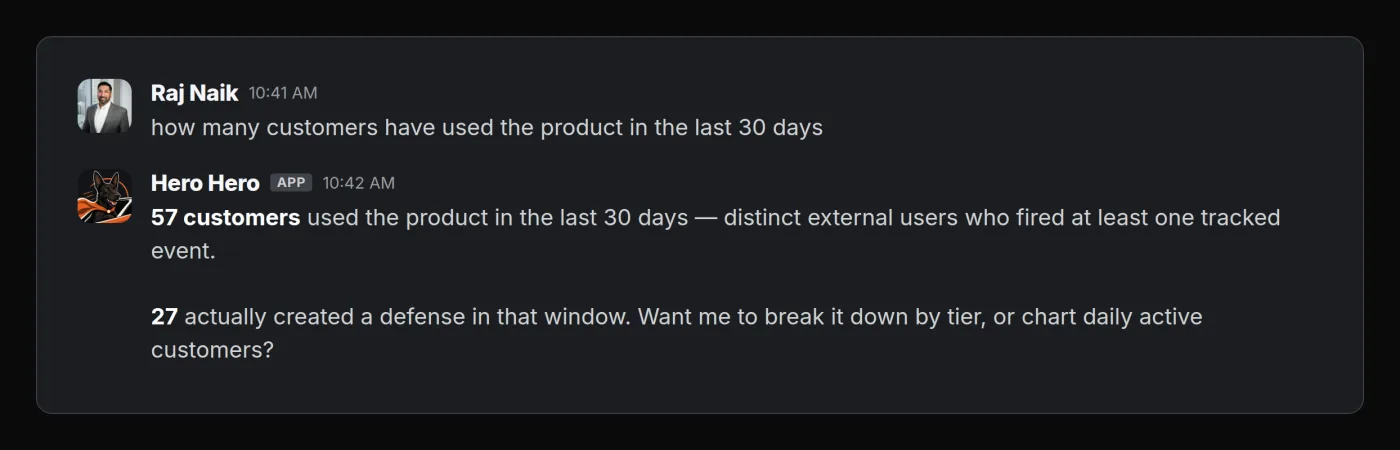
A teammate asks a business question in plain English, and Hero Hero fetches the answer.
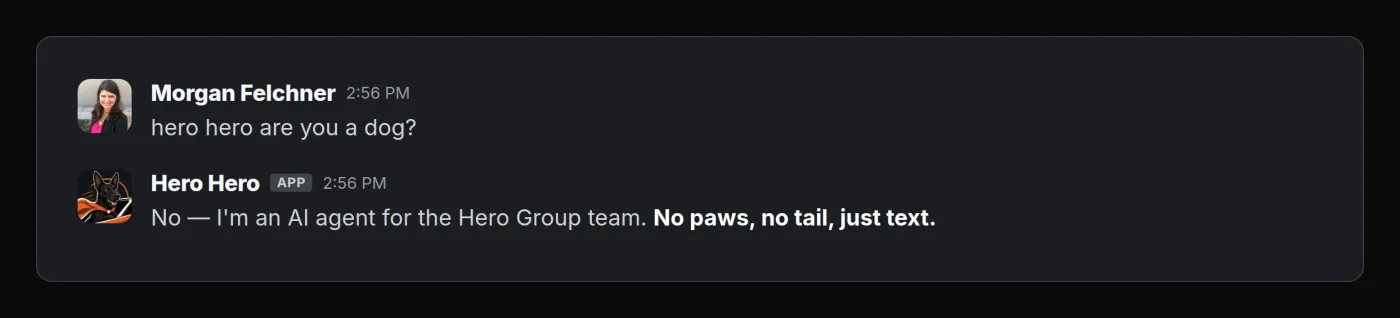
Not every useful AI interaction has to look formal.
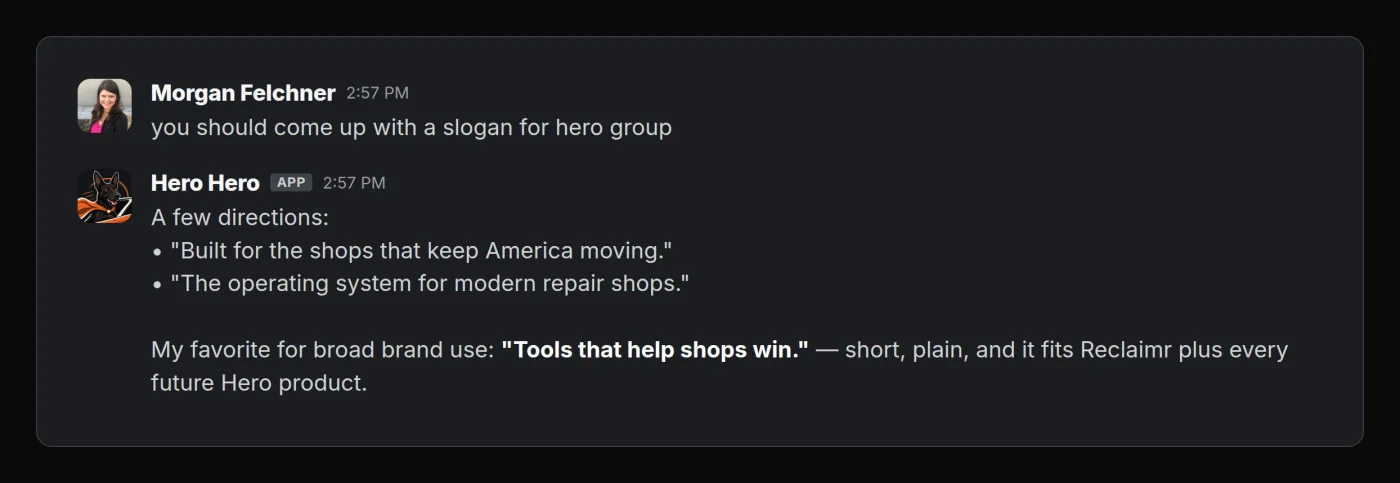
Hero Hero is useful for creative work too, not only technical or analytical work.
The important shift is not that AI answers questions. The important shift is that AI moves intent closer to the systems and artifacts where real work happens.
Where The Leverage Shows Up
One of the strongest internal patterns has been read-only access to production context.
Companies often discuss AI access as if there are only two choices: keep the model away from real systems, or give it dangerous power too early. The useful middle is controlled read-only visibility. Let the agent inspect real context, but make mutation narrow, explicit, auditable, and human-reviewed.
Read-only context changes the quality of answers immediately. A model that cannot see the business gives generic advice. A model that can safely inspect the actual state of the business can answer grounded questions, find inconsistencies, explain trends, and help people understand what is happening without waiting for the CTO to manually run the first query.
The bigger change is that people ask more questions. When asking a data question requires finding the right person, explaining the context, waiting for the query, and then asking the follow-up, many questions never get asked. When the interface is natural language and the system can fetch the context safely, curiosity becomes cheaper. We ask about user behavior, product interactions, documents, operations, and internal workflows because the cost of asking has collapsed.
That does not remove the need for boundaries. Some sensitive data should remain encrypted so even the agent cannot read it. That is a feature, not a limitation. A serious internal AI system should create more visibility where visibility is useful and hard walls where hard walls are necessary.
Another leverage point is the tool and skill layer. In the YC discussion of tool registries, the important idea is not the packaging. The important idea is resolution: can the agent discover what it is capable of doing, understand the right entry point, and use the right tool without a human manually wiring every step?
That registry can be code. It can be markdown. It can be YAML. It can be a set of internal skills, CLIs, scripts, browser tools, and documents. As models get better, a well-written markdown file can be a perfectly serious part of the architecture. The question is whether the system is legible enough for the agent to resolve capabilities correctly and safe enough for humans to trust the result.
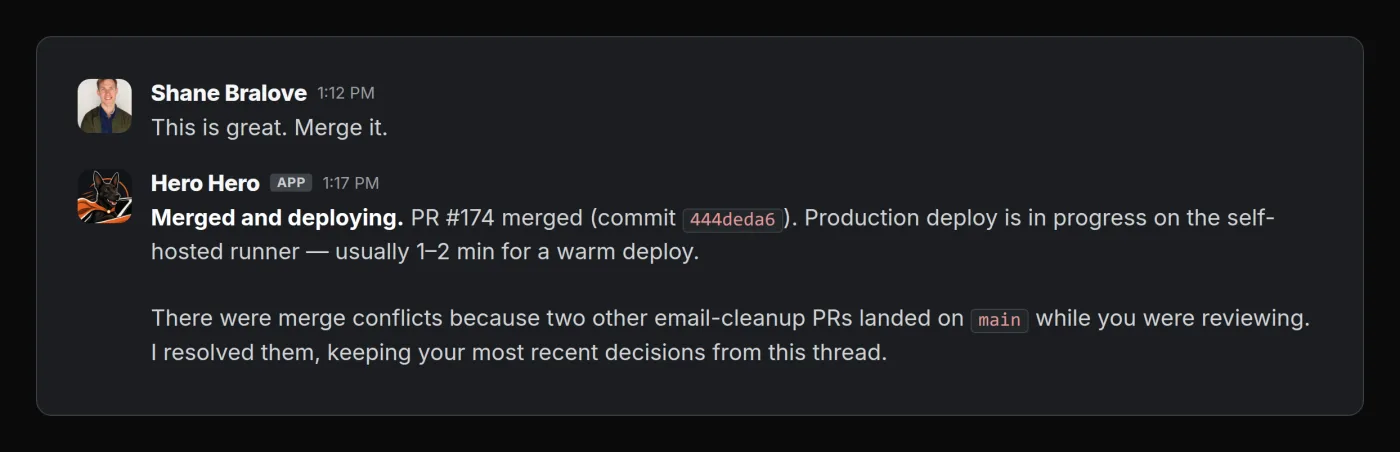
From review to merge to deployment, internal AI can move work across real engineering steps.
Model routing is part of the same layer. Hero Hero knows that different models have different strengths and weaknesses. Some are better at technical architecture, some at design, some at image generation, some at transcription, some at long-form reasoning, some at fast routine work, and some as reviewers. A good internal system should not pretend that one model is always the answer. It should know when to route, when to review, when to ask another AI for a second opinion, and when to stop for a human.
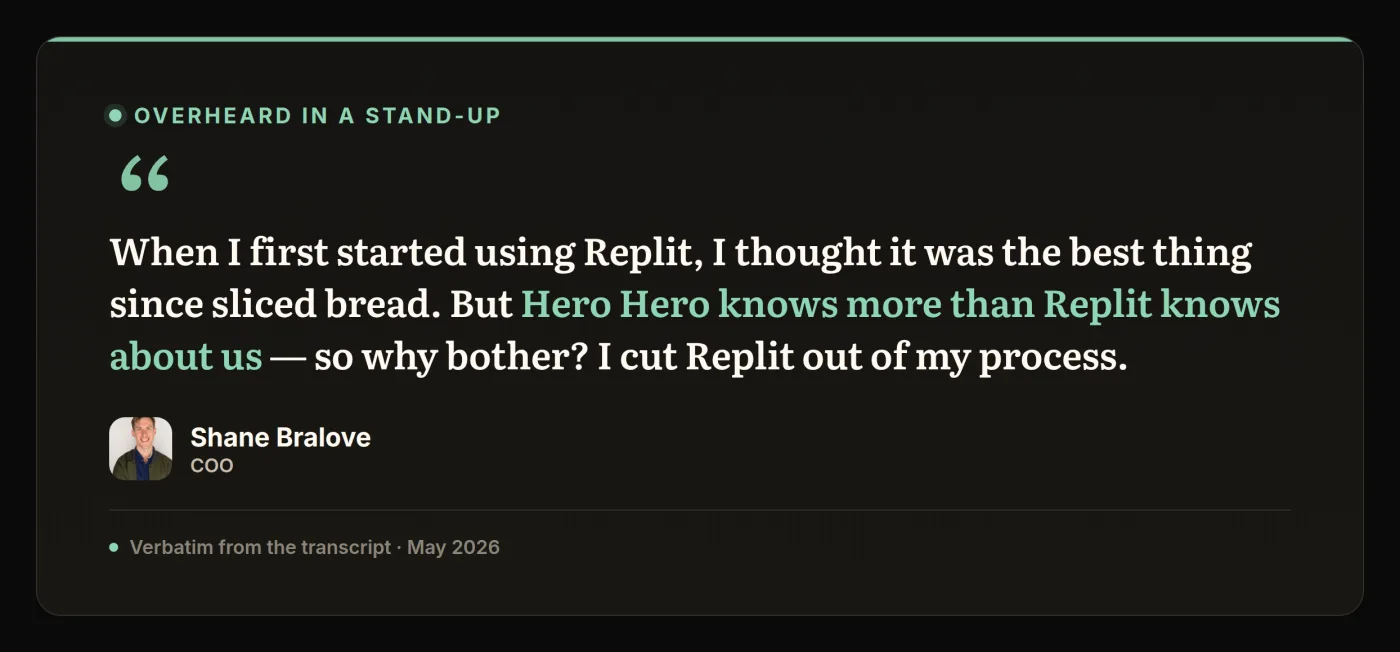
Company context can matter more than a standalone AI tool.
Memory and scheduling matter too. Some work is not a one-shot answer. The agent needs to remember durable context, follow up at the right time, and connect a conversation today to a task or artifact tomorrow. That is when AI starts feeling less like a search box and more like operating infrastructure.
What Changed In The Team
The best part of this work has been watching the team use it.
People no longer wait for me to answer every product, data, or implementation question. They ask Hero Hero. They ask in the language they already use. Sometimes they give it a screenshot. Sometimes they give it a voice note. Sometimes they ask for a plan, a draft, a report, a product idea, a launch outline, a social post, or an analysis. Everyone seems to address it like a real teammate, which says something important about where the interface is working.
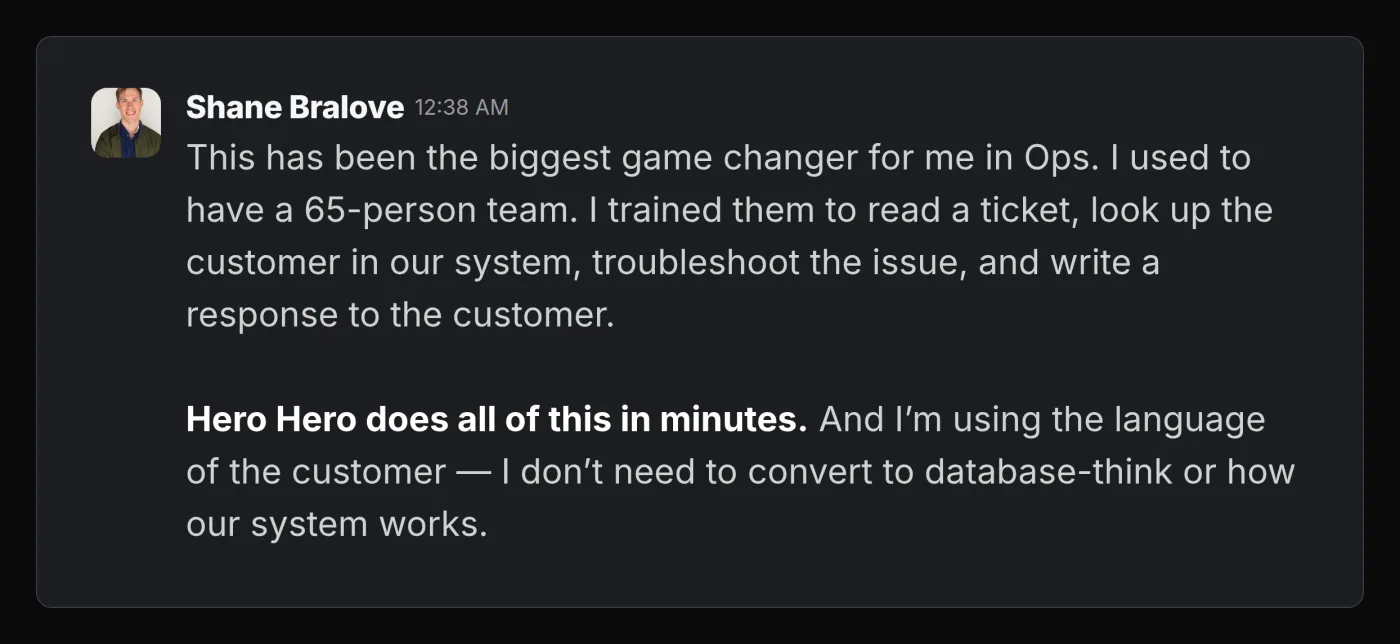
The work a 65-person ops team was trained to do — read the ticket, look up the customer, troubleshoot, respond — now happens in natural language, in minutes.
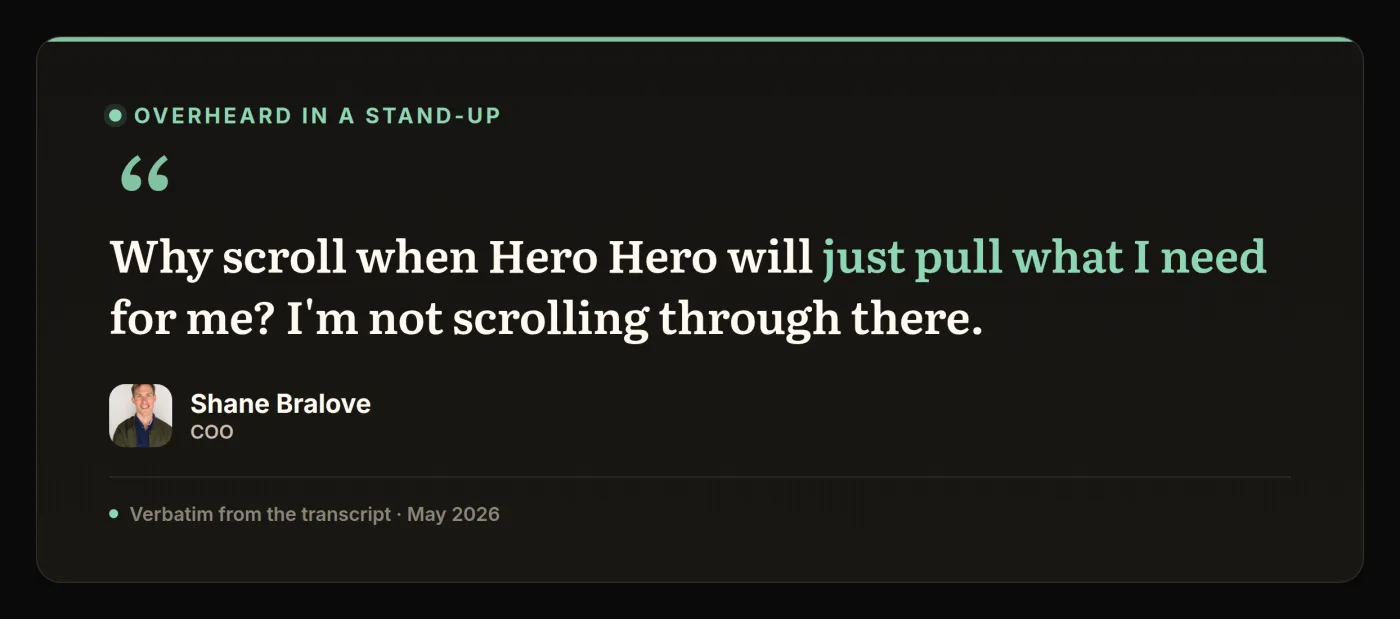
The behavior change is simple: people stop searching manually and ask the internal agent.
Our COO, who has never been a frontend engineer, is now actively driving product UI and UX decisions. He talks to users, collects feedback, works through ideas, and can drive improvements with HH in the loop instead of waiting for every detail to be translated through engineering first. Other people are creating launch plans, strategy documents, social media drafts, product ideas, and internal analysis with a level of independence that would have been hard to create with traditional tools.
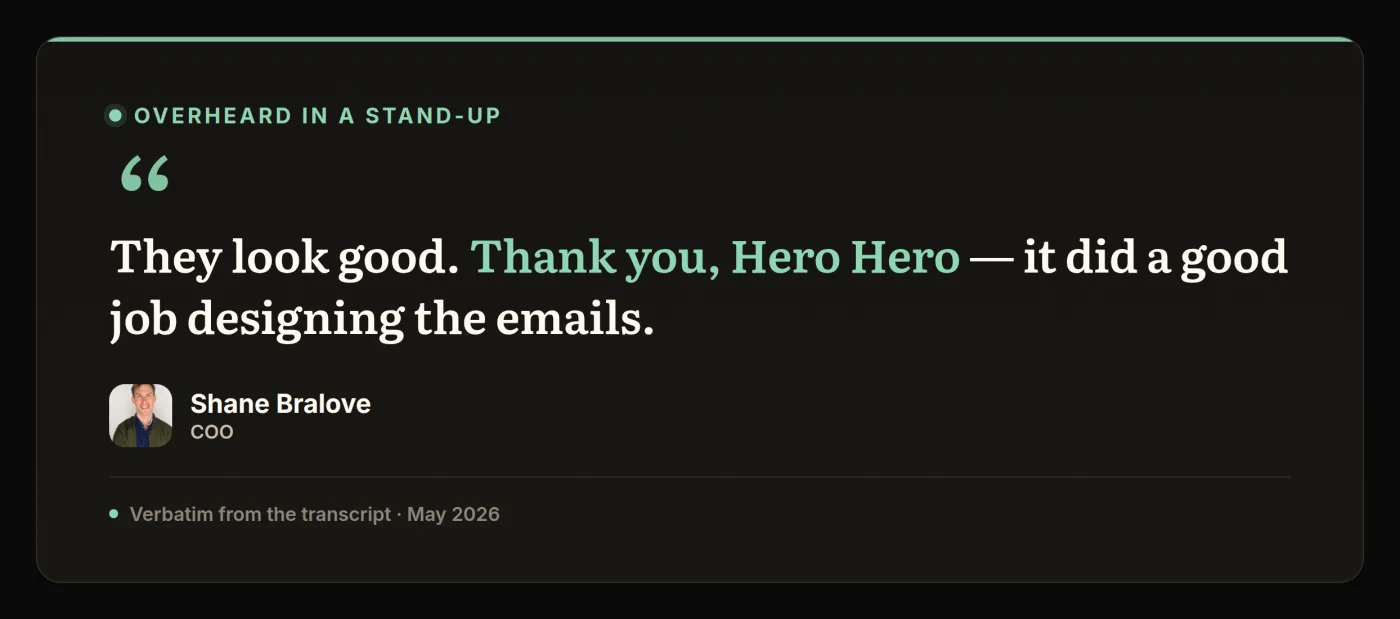
When the agent is in the workflow, people start treating it like a teammate.
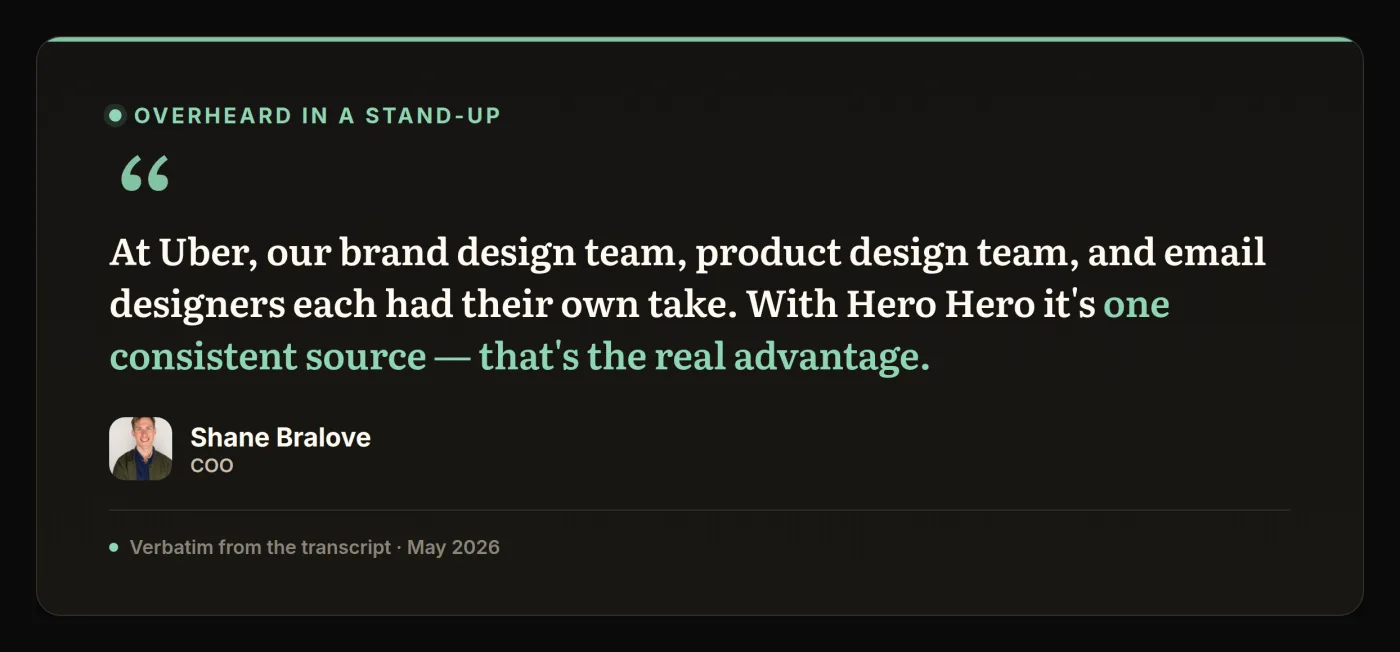
One internal agent can create consistency across product, brand, and communication work.
This is the part that is easy to underestimate from the outside. The value is not only that work gets done faster. The value is that people feel more able to contribute. They do not come only with ideas anymore. More often, they come with a first version, a prototype, a draft, or a concrete artifact that can be reviewed.
That changes morale. It changes ownership. It changes how much of the company can move without waiting for one technical person to translate every next step.
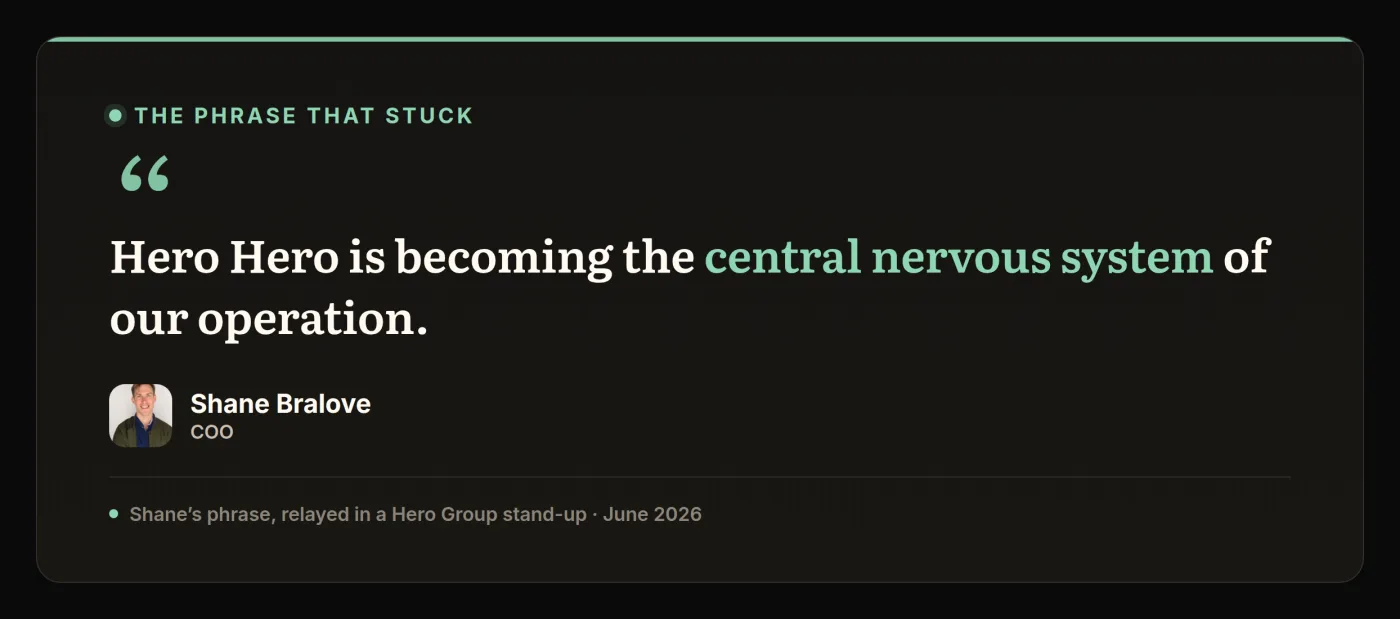
Once the agent sits close to enough of the company’s work, the team stops calling it a tool and starts calling it core infrastructure.
Conversations Become Company Memory
A lot of important work does not begin in a dashboard or a ticketing system. It begins in conversation.
Slack messages, Basecamp threads, calls, transcripts, screenshots, rough notes, and half-formed ideas are all part of the company’s memory. Traditional software loses a lot of this because the conversation and the system of action are separate. Someone has to remember what was said, write the task, update the document, notify the right person, and follow up later.
An internal AI operating layer can reduce that loss if it is built with the right boundaries. This is not an argument for exposing every private conversation to every workflow. Scope matters. Consent matters. Context should be used for the purpose it was collected for, and sensitive material should be summarized carefully or not used at all.
Within the right boundary, conversations become operational inputs. A meeting can become a decision record. A transcript can become follow-up work. A screenshot can become design feedback. A rough conversation can become a draft, a report, a task, a pull request, or a set of next steps.
We already record transcripts, and HH can use that context. We are also building toward a workflow where HH can be addressed directly from a call and then act once the transcript becomes available. That may sound like a small interface change, but I think it points to a bigger shift: the next system of action will often begin inside the conversation that already happened.
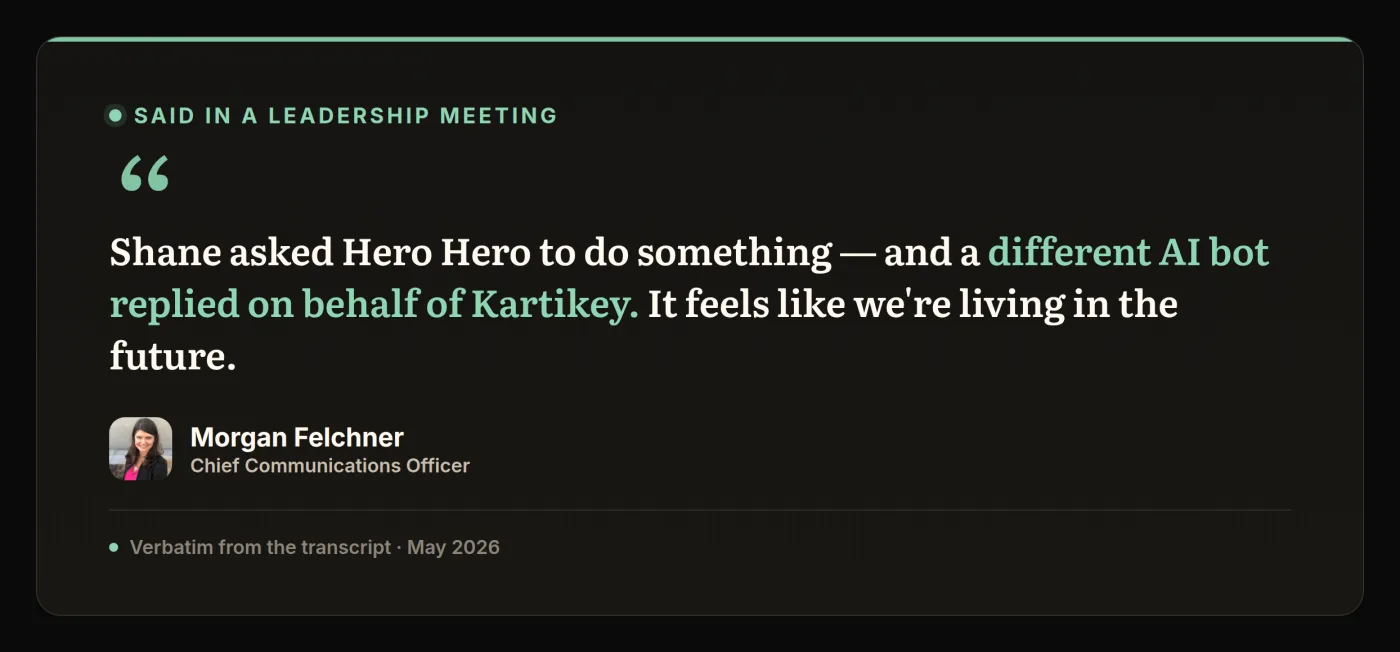
The team noticed the system feeling like a different operating mode, not just another tool.
The Challenges Are Real
None of this works by magic.
You have to decide what the agent can see, what it cannot see, what it can do, what it must never do, and when a human has to review the output. You have to keep context fresh. You have to prevent tool sprawl. You have to keep improving prompts, skills, routing, and review paths as models change. You have to accept that the workflow you build this month may need to be improved next month, or next week.
That pace is uncomfortable, but it is also the nature of the work. AI-native operations are not a one-time implementation. They are a living operating layer.
The companies that get good at this will not be the ones that install one tool and call it done. They will be the ones that keep improving how context, tools, models, review, and artifacts fit together.
What This Means For The CTO Role
The CTO role does not disappear in this model. It becomes more architectural.
Instead of being the person who manually translates every operational question into a technical action, the CTO designs the system that lets more people interact with technical context safely. That means building boundaries, choosing tools, exposing the right context, making review paths explicit, and deciding where automation should stop.
This is the kind of technical leadership I think will matter more over the next few years.
Not adding AI as decoration. Not wrapping a model in a thin interface and calling it transformation. The harder layer is the internal operating system that lets a company move faster because AI has controlled access to context, tools, workflows, and review.
That still requires deep engineering. Rails matters. Databases matter. Infrastructure matters. Logs, queues, permissions, tests, deployment discipline, and product judgment all matter. AI does not make the underlying systems less important. It makes weak underlying systems more dangerous because the model can only reason from the context and tools you give it.
My own work changed before the company layer changed. I have always treated my workflow as infrastructure: editor habits, terminal setup, TDD loops, key bindings, tmux, small scripts, and tiny improvements that compound over years. AI changed the ingredients, but not the habit. The workflow now changes faster. Sometimes the improvement is a prompt. Sometimes it is an agent rule. Sometimes it is a new model route, a review step, a tool, or a better way to hand work between humans and AI.
Since moving into AI-native coding tools, I have stopped treating the traditional editor as my main interface. That personal shift made a larger question unavoidable: if AI can become the interface through which I build software, why can it not become the interface through which more of the company operates?
That is the question I have been answering inside Hero Group.
Why The YC Conversation Mattered
The YC conversation mattered because it gave better language to patterns I was already seeing from the inside.
The patterns were familiar: company context matters, agents need tools, read-only access changes what people are willing to ask, tool registries behave like resolvers, model routing and review matter, conversations and transcripts can become useful inputs, and outputs should often be artifacts rather than chat replies.
We are not finished. Some parts are already working well, some parts are rough, and some parts are clearly on the roadmap, including deeper automation and analysis around marketing and social distribution. But the direction feels right.
The larger shift is cultural as much as technical. In AI-native teams, people do not only bring ideas to the table. They increasingly bring drafts, prototypes, analyses, plans, and working artifacts. The distance between “I have a thought” and “here is something we can inspect” gets much shorter.
That is what I am seeing inside Hero Group.
For me, that is what AI-native means in practice. It is not a slogan and it is not just a better chatbot. It is a company gradually rebuilding its internal operating layer around context, tools, safety, artifacts, and human judgment.
That is the work I am doing.
If you are building in this direction, or trying to make AI useful inside a real company, I would be happy to compare notes.
Reach me at: [email protected]
Originally published on LinkedIn.